Why doesn't an engineering firm scale like a software company?
A software company adds a server and serves ten times the customers. An engineering firm adds an engineer and gains one engineer's capacity.

Because in an engineering practice the product is you: your judgment, your experience, and your professional stamp on documents that affect thousands of people. A software company can add a server and serve ten times the customers. You add an engineer and gain roughly one engineer's capacity, maybe one and a half with good systems, and you take on a new set of coordination problems along with it.
That is not a failure of ambition. It is the shape of the business, and once you accept it you plan differently.
Why does a server scale ten times and an engineer not?
Software copies. Once the feature is written, the next thousand users cost almost nothing to serve. None of that is true of engineering. Every project is designed for one site, one client and one set of constraints, and every deliverable carries a licensed engineer's signature on it.
You cannot run the same design twice and call it two projects. So the cost of your next client is not near zero. It is a person's hours plus the review that makes those hours defensible, and both are paid in time you cannot buy back.
That is also why you cannot automate the core expertise clients are paying for. You can automate pieces of the work around it. The judgment itself stays with the person who signs.
Why does adding engineers multiply complexity instead of output?
Adding more engineers does not automatically multiply your output, it multiplies your complexity. That sentence took me a while to believe, and longer to plan around.
Every new engineer needs three things at once: work to do, someone to check that work, and a client willing to trust the name attached to it. Each of those is a task for you or for whoever reviews, and none of them shows up on an invoice.
Then there is the coordination. Two engineers on one design need a decision about who owns which part. A third needs to know what the first two settled. A small firm feels this as a slowdown. A larger firm feels it as the reason a big team can be slower than a small one on the same scope.
Good systems soften the problem. They do not remove it. That is where the one and a half comes from: same people, fewer repeated decisions, less rework, and a checklist that already knows what nearly went wrong the last time.
What does "you are the product" mean for how I run the firm?
Clients are not buying a thing they can hold or software they can download. They are buying your judgment on a problem they cannot solve themselves, and your stamp on the answer. That single sentence decides what you can hand off.
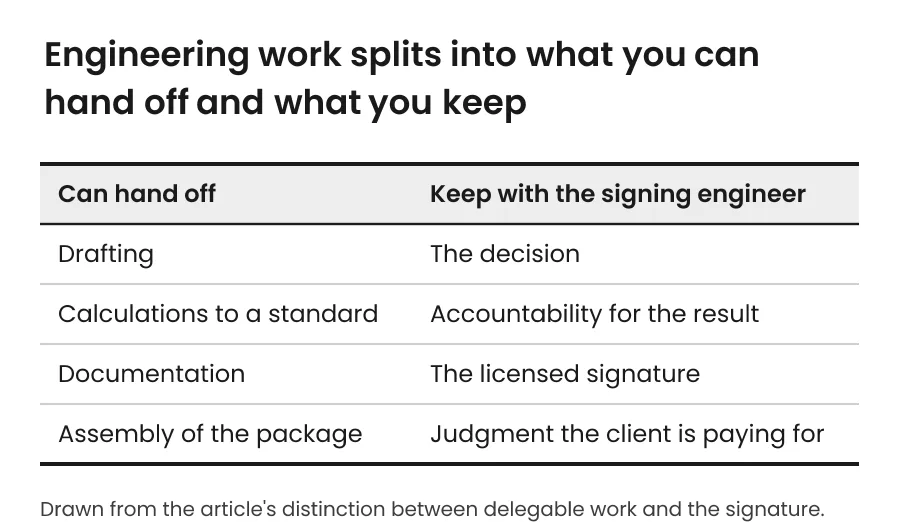
What you hand off is the work around the judgment: drafting, calculations to a standard, documentation, the assembly of a package. What you keep is the decision and the accountability for it, because a licensed engineer cannot delegate the signature.
It changes the sales motion too. A city manager may take your proposal to a board next month. A firm principal may need three partners to agree before anything moves. Urgency tactics built for a checkout page do not survive contact with that approval process.
Your job in that window is education: helping them understand why your approach fits their situation, and being willing to wait while they decide.
Why does general business advice not fit an engineering practice?
Most business advice online assumes you sell widgets or run a software startup. When I went looking for guidance after I left my job in 2017, I found plenty of both, and almost none of it translated to what we do.
Hockey stick growth, one strange trick, ten times revenue in a year: those models assume the product copies at near zero cost. Ours cannot. Every project requires licensed oversight, and licensed oversight means a person with a name and a license number taking responsibility for the result.
So when a tactic asks you to promise more than a licensed engineer can check, or to compress a review to hit a number, the tactic is not aggressive. It is wrong for your business.
What actually compounds in an engineering firm, and how should that change my plan?
The proof stack. Projects you have delivered, clients who call you back, systems your team uses to produce the next project faster than the last one. That stack grows one delivered project at a time, not in a curve.
A proof stack is not a portfolio page. It is the set of projects a future client can actually check, with outcomes you can describe plainly and references who will answer the phone when someone asks.
My firm is at $2M+ a year with 40+ people since 2017, and the lesson has held the whole way: each hire added relationships and reviews to manage, not a multiple of output.
The growth question changes shape. Instead of asking how I double revenue this year, ask what I can deliver this year that I could not deliver last year, and what system makes that repeatable.
Four things follow for hiring and planning:
- Hire against a named project and a system that already exists, not against a forecast.
- Count review capacity before you count backlog. Work nobody can check is not capacity; it is a queue with a risk attached.
- Put one system in place for every engineer you add: a checklist, a template, a standard detail somebody has already argued through once.
- Judge the year on value delivered and clients who came back, not on how fast the org chart widened.
What should I do next week?
Take everything your firm owes a client this month and mark what only a licensed engineer can sign. That number is your real capacity for the month, not the headcount on the org chart.
Then write down the one system that would let your next engineer produce at one and a half instead of half. If you cannot name it, you are not ready to hire. You are ready to write the checklist first.
And stop measuring your firm against a software company. They add a server and wait for the customers to arrive. You add judgment, and judgment has to be checked by someone who carries the same license you do.
From the book Engineer Your Freedom
Michael Groselle, P.E., is the founder of Modern Engineering Solutions, a multi-state water and wastewater engineering firm. He left salaried engineering in 2017 and built the firm from one resignation letter and zero clients to more than $2M in annual revenue, with a team of 37 and 525+ completed projects.
Sold on Amazon. Prefer the Kindle edition? Buy it on Amazon ($9.99).