Why does my best engineer do all his real work on Saturday?
Saturday work from a senior engineer is a resignation forecast. The fix is the structure of the workweek, not more stamina.

Because the normal workday is filled with questions a system should already answer, and Saturday is the first stretch long enough to do the actual engineering. That is not dedication. It is a resignation forecast, and it is a problem with your firm's structure, not with his stamina.
What does Saturday work from a senior engineer actually tell me?
It tells you where his hours go. During the week he answers questions about the drawing set, the client's latest change, the submittal package, the schedule, and what the contractor meant on the phone. Each one is small. Together they eat the day.
The design work that needs an hour of quiet thinking gets pushed to the edges, and the only edge long enough is the weekend. If your best engineer keeps doing this month after month, the pattern is in your week, not in his personality.
Treat it as data. A senior engineer who works Saturdays is telling you, without saying it, that the firm cannot produce its work inside its own hours.
Why is this a resignation forecast and not a compliment?
Because nobody keeps that schedule forever. The engineer is not choosing Saturday out of love for the work. He is choosing it because the alternative is falling behind, and the Saturday is what keeps his projects from slipping.
This is Grandfather Engineering in its purest form: the firm bills the hours, the founder and the senior engineers absorb the overflow, and the price of growth is paid in weekends. Modern delivery is the alternative. The hours are a design choice, and a firm can choose a different design.
For a while he absorbs it. Then he starts doing the arithmetic. He compares what the firm pays him to what the firm bills for his week, and he notices how much of that week went to questions that a firm with better structure would not have needed to ask him.
That comparison has only one ending. The resignation usually comes months after the decision, and it arrives as a surprise to the owner who saw the Saturday hours as loyalty.
What should answer the questions that eat his week?
This is the part owners skip. They hear the problem and reach for sympathy, a bonus, or a stern note about work-life balance. None of those change where the hours go on Monday.
The real question is which of his interruptions have a repeatable answer that could live somewhere other than his head. In my experience, they usually fall into three groups.
- Repeat questions from the same few people. Someone asks the same thing every week because the answer was never written down.
- Approvals that route through him by habit. He signs off because he always has, not because the decision needs his judgment.
- Status chasing. He spends his day finding out where a package stands, when a schedule would have told him.
Each group is a system waiting to be built. None of it requires new software on day one. It requires someone to write down the answer once and point people to it.
How do I find the hours before I redesign anything?
You cannot manage what you have not counted. For two weeks, ask your senior engineers to log the days they work past their normal hours and roughly how many hours it was.
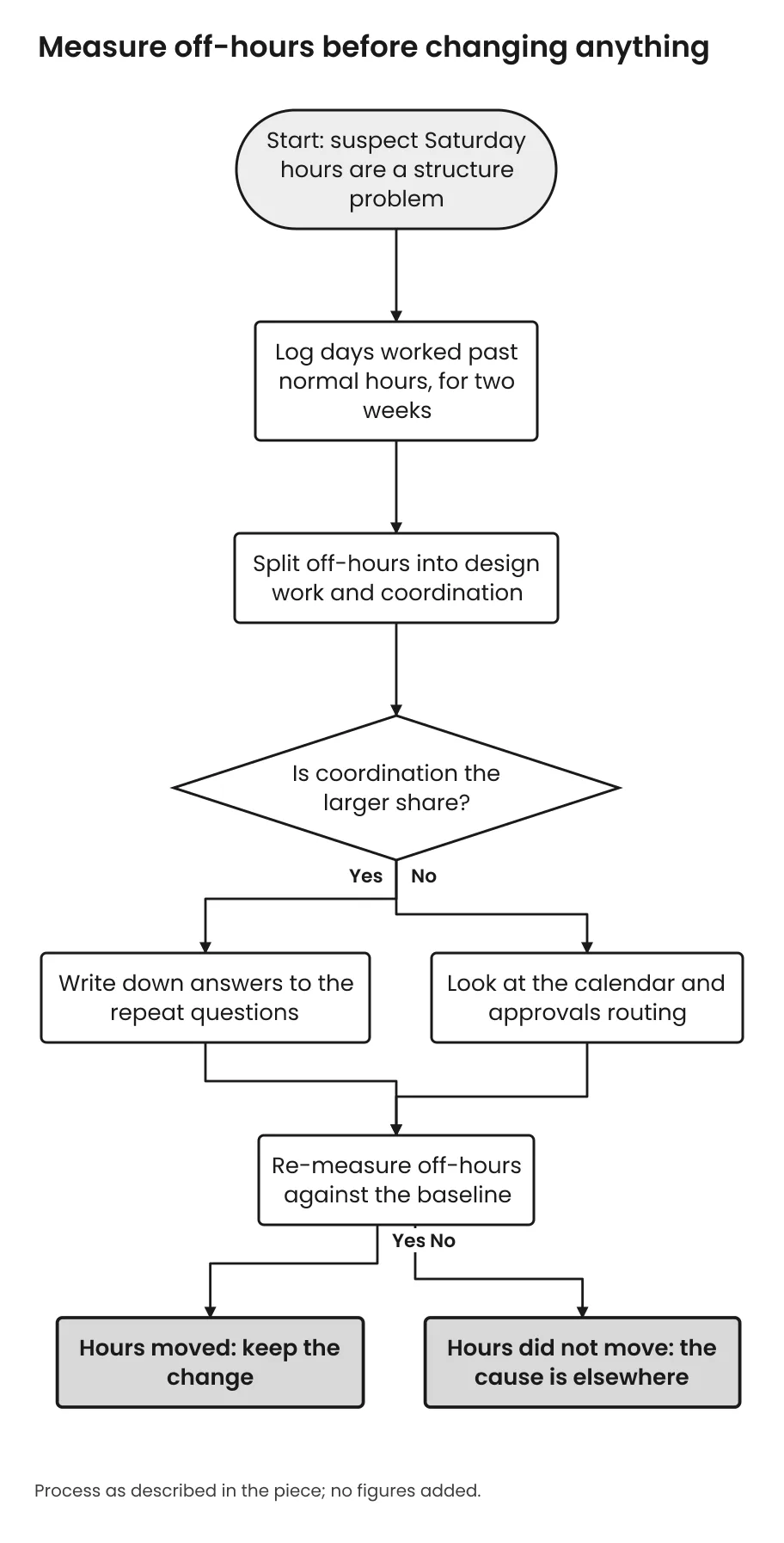
Keep it short enough that people actually do it. A number per person per week is enough. You are not building a timesheet. You are looking for a baseline you can compare against after you change something.
Then ask one more question: of those off-hours, how much was real design work and how much was catching up on coordination that could have happened at four in the afternoon?
My read is that the coordination share is usually larger than the design share. Either way, the log tells you, and the log is what you act on.
What does it cost the firm to keep it this way?
Put a number on it and the conversation changes. The hours a senior engineer works off the clock are hours the firm is already paying for in salary and already losing in slippage. Saturday work does not add capacity. It protects a week that was already too fragmented to deliver.
Run the arithmetic on your own firm. Take the hours your senior engineers work off the clock each month and multiply by the rate their time is worth to the business. Then ask whether the interruptions that caused those hours were worth that many dollars.
A written answer to a repeat question costs a few minutes once. The same question asked of a senior engineer twenty times costs far more, because you also pay for the Saturday that follows it.
What do I do next week?
Ask your best engineer one question and then stay quiet: what is the thing that most often pulls you away from the work you are actually paid to do?
Write down the first three answers. Do not commit to solving them yet. Just find out whether the answers are the same for your other senior engineers.
Then pick one and build the smallest system that answers it, whether that is a short written standard, a shared status board, or a rule that a certain decision no longer routes through him. Track your off-hours baseline before and after, so you can see whether it moved.
If the hours do not move, the problem is somewhere else, and now you have the numbers to look for it. The structure is the fix. More stamina is not a plan.
From the book Engineer Your Freedom
Michael Groselle, P.E., is the founder of Modern Engineering Solutions, a multi-state water and wastewater engineering firm. He left salaried engineering in 2017 and built the firm from one resignation letter and zero clients to more than $2M in annual revenue, with a team of 37 and 525+ completed projects.
Sold on Amazon. Prefer the Kindle edition? Buy it on Amazon ($9.99).