What multiplier should I use to price my engineering services?
Engineering multipliers come from large firms with heavy overhead. Here is why a small firm should price on what the project is worth to the client.

You should not start with a multiplier. Start with what the project is worth to the client, then check that you can deliver that value at a profit. A multiplier shows what a large firm needs to cover its own costs. It does not show what your work is worth to the person paying for it.
Where do engineering multipliers come from?
Every firm I worked for talked about multipliers. "We need to hit 2.5x on this project." You have probably heard "a 3.0 multiplier" or "2.8x on labor."
Here is how it works in a traditional firm. They take an engineer's salary and benefits, say $80,000 a year, and multiply by 2.5 or 3.0. That gives a billing target of $200,000 to $240,000. The difference pays for overhead, profit and non-billable time.
For a larger firm with office space, support staff, unused capacity, marketing budgets and layers of management, that math makes sense. They need those multipliers to stay solvent.
Why does the multiplier fail a solo practice or small shop?
I see two problems.
- Your overhead is different. You may work from home or a small office. Your overhead might be 20 percent of revenue instead of 50 percent. Defending a 3.0x multiplier on that cost structure makes your price arbitrary.
- You are borrowing a pricing model built for a different business. A large firm spreads risk across dozens of projects and hundreds of people. Its prices carry unused staff time, training and business development. You can't spread risk that way, and your price shouldn't pay for costs you don't have.
I spent months trying to reverse-engineer which multiplier I should use. Was it 2.2x? 2.8x? Should I adjust for lower overhead? It nearly broke my brain.
What question should I ask instead?
A mentor stopped me mid-sentence when I asked him how to calculate pricing. "Forget all that," he said. "What is this project worth to your client?"
The question I use now is this: what is this project worth to this client, and can I deliver that value profitably?
That second half matters. Value-based pricing is not a license to charge whatever you like. You still have to cover the cost of delivering the work, the cost of running the business and a profit to reinvest. Value tells you what the price can be. Your costs tell you whether the job is worth taking at that price.
What does this look like on a real project?
My mentor gave me a simple example. A developer needs a wastewater permit for a 200-lot subdivision. Without the permit, the whole project is dead in the water. The land earns nothing while property taxes and loan interest pile up.
Say the project is worth $20 million to the developer, and your engineering work is the bottleneck. What is that permit package worth? It is not your hourly rate times your hours. It is worth what it creates for the client.
Then he pushed on speed and quality. In his example:
- Deliver the permit in sixty days instead of 120, and you have saved two months of carrying costs, maybe $50,000 or more.
- Get approval on the first submittal instead of after three rounds of revisions, and you have saved four months of delay.
The old way of thinking was: "This will take 40 hours at $150 an hour, so I should charge $6,000." The new way is: "This permit unlocks a $20 million project, and my experience means it gets approved faster with fewer problems. What is that worth?"
In that example, the answer is significantly more than $6,000. Those figures are an illustration, not a result you can count on.
Does this only change the price?
No. It changes which clients you go after and how you position your services.
Picture a municipality that gets its wastewater permit approved six months faster because of your experience with the process. That is worth tens of thousands in carrying costs and lost revenue. Take it as an illustration, not an outcome. Your job is not to be the cheapest option. Your job is to deliver value that far exceeds what you charge.
This is the difference between Grandfather Engineering and modern delivery. In my view, billing hours pays you for time spent, not for the value you create. Pricing on value points your attention at what the client gets, not at how long you took.
How do I know the price is actually working?
Check the numbers that answer the right question. Gross profit is revenue minus what you paid others to deliver the work, such as subconsultants, materials and contractors. Leave your own time out of it on purpose.
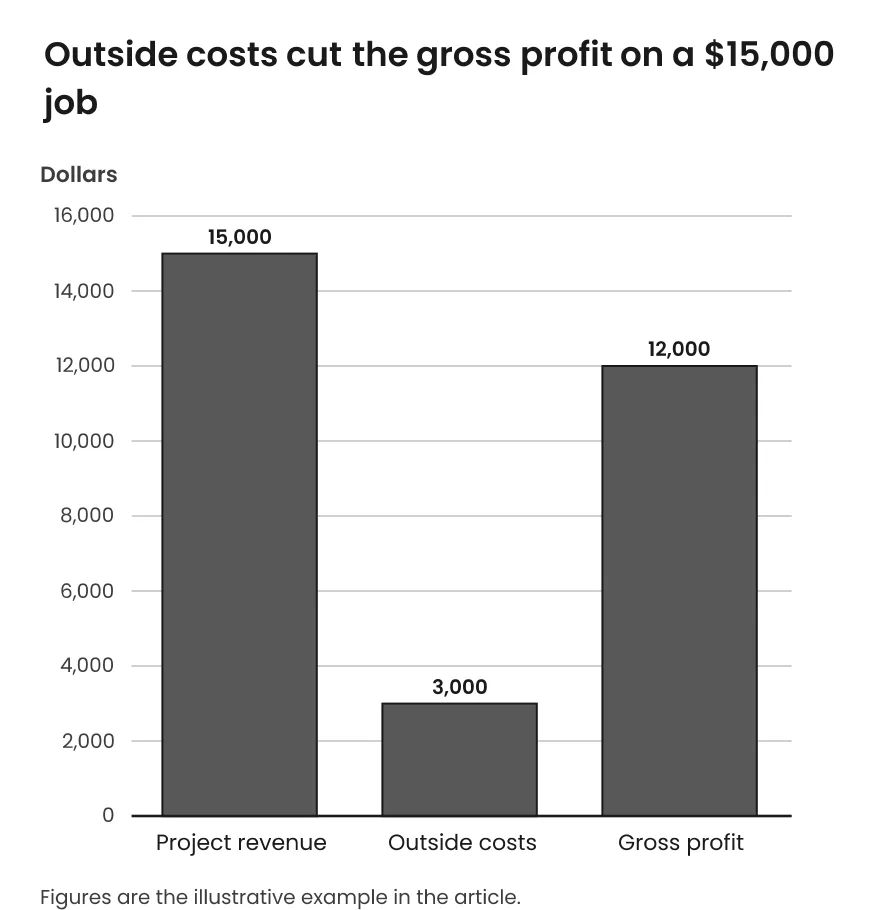
Take a $15,000 project with $3,000 in outside costs. Gross profit is $12,000. Then pay yourself market rate for your PE time. If nothing is left, you don't have a business. You have an expensive job that needs heroics to survive.
I would also watch accounts receivable. You can be profitable on paper and broke in reality if clients don't pay promptly.
What should I do next week?
Pick one project you are pricing, or one you recently priced. Write down three things before you touch a rate sheet.
- What the project is worth to the client, including what delay costs them each month.
- How much time your experience could save them, in months, and how many review rounds it could avoid.
- Your cost to deliver, so you can see whether the price you land on leaves real profit after paying yourself.
Then compare that price to hours times rate. Look hard at the gap between the two, and ask what the project is worth before you ask which multiplier to use.
From the book Engineer Your Freedom
Michael Groselle, P.E., is the founder of Modern Engineering Solutions, a multi-state water and wastewater engineering firm. He left salaried engineering in 2017 and built the firm from one resignation letter and zero clients to more than $2M in annual revenue, with 40+ team members and 300+ completed projects.
Sold on Amazon. Prefer the Kindle edition? Buy it on Amazon ($9.99).